Bewertung 5.0 von 5

Mega Menu — Elementor Paste Block

Kilimanjaro Tour Operators · Tanzania, East Africa

Mount Kilimanjaro Guide

Routes, costs, success rates & best time to climb. Everything you need to know — from first question to standing on Uhuru Peak (5,895m).

Can you climb without a guide?
No. Tanzanian law mandates a licensed guide for all climbers. Solo climbing is strictly prohibited.

Who can climb Kilimanjaro?
Anyone aged 10+ with determination. No technical experience required — just fitness and mental resilience.

5,895m

Summit Elevation

19,341 ft · Uhuru Peak

95–98%

Success Rate

Northern Circuit Route

$2K–$6K+

Average Total Cost

Per person based on route

7 Routes

Official Paths

Each with unique profile

Beginner's Guide

A Complete Beginner's Guide to Climbing Kilimanjaro

Unlike technical mountains like Everest, Mount Kilimanjaro is a trekking peak. It demands strong determination, mental resilience, and physical preparation — but no rock climbing skills.

Best Months

Jan–Mar & Jun–Oct

Success Rates

65% – 98%

global-money

Average Cost

$2,000 – $6,000+

Official Routes

7 established paths

  • You do NOT need technical climbing experience
  • The Lemosho Route (8–9 days) is recommended as the most successful
  • Anyone with moderate fitness can summit Kilimanjaro
  • Longer itineraries dramatically increase summit success rates
“Pole Pole” — Slowly, Slowly

The guiding philosophy of Kilimanjaro. A deliberate, slow pace is the single most effective way to reach Uhuru Peak safely.

Our Commitment – Explore Trekking Adventure
Our Commitment

Every Expedition Begins With Taking Care of People

On Kilimanjaro and Mount Meru, a great climb depends on quality meals, reliable equipment, and a crew that is genuinely respected — from summit day to the walk back down.

Plan Your Expedition →

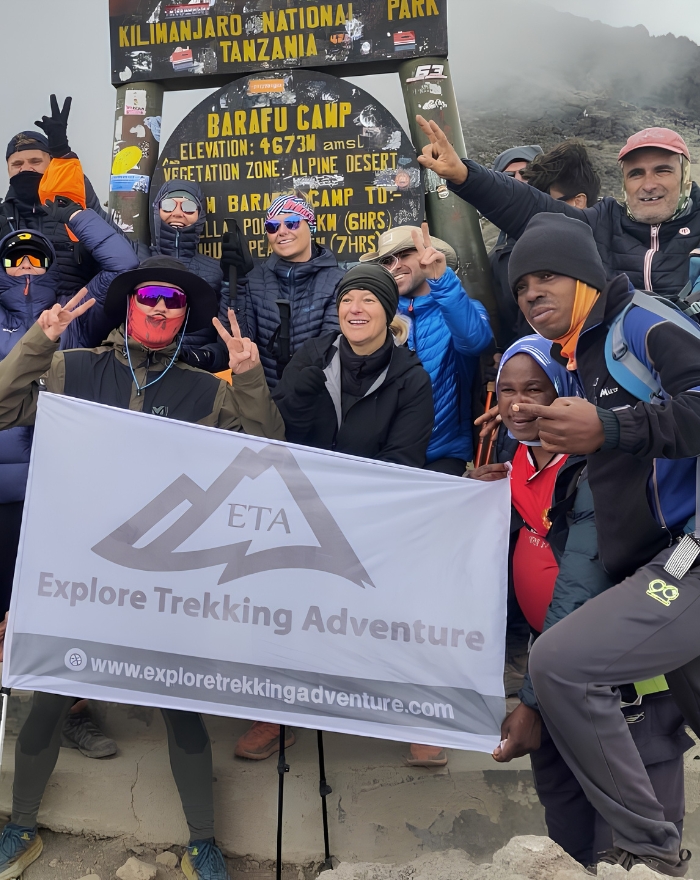
Explore Trekking Adventure team on the mountain

"The mountain rewards those who prepare well — and treat their team even better."

Fresh, Nutritious Meals — Daily Included

Whether you are climbing Kilimanjaro or trekking Mount Meru, expect freshly prepared, balanced meals every day of your expedition — along with high-quality camping equipment and comfortable mountain tents.

A Well-Fed, Fairly Paid Crew Our Standard

Our guides and porters receive sufficient, nutritious meals on every expedition. We maintain fair wages, timely payments, and professional working conditions — because a motivated, healthy crew is what makes every climb possible.

Responsible Trekking You Can Trust Ethical Practice

Booking with Explore Trekking Adventure means supporting a company that values clients, guides, and porters equally. Our commitment to safety, ethical staff treatment, and genuine service creates experiences that stay with you long after the summit.

Empowering Local Communities Our Impact

Every Kilimanjaro trek and Tanzania safari you book gives your journey a deeper purpose. We support girls from rural, disadvantaged families by providing essential sanitary items, helping them stay clean, healthy, and consistently in school.

"By choosing Explore Trekking Adventure, you are supporting a trekking company that values its clients, guides, and porters alike."

Book Your Climb

Seasons & Weather

Best Time to Climb Mount Kilimanjaro

The best time to climb is during the dry seasons: January–March and June–October, when weather is more stable, skies are clearer, and trails are safer. While Kilimanjaro can be climbed year-round, the rainy seasons in April, May, and November bring wetter and more challenging conditions

Safer Trails

Low rainfall means less slippery paths and significantly reduced risk of accidents on steep sections.

Better Visibility

Clear skies give you unobstructed views of the summit, glacier, and the sweeping plains of Tanzania below.

Higher Success Rates

Dry season climbers consistently achieve higher summit success rates due to stable, predictable weather.

January

Excellent

Warm, mostly dry

February

Excellent

Warm, clear skies

March

Fair

Increasing rainfall

April

Avoid

Heavy rain

May

Avoid

End of rainy season

June

Good

Dry season begins

July

Peak Season

Cool and dry

August

Peak Season

Dry, clear views

September

Peak Season

Dry, slightly warmer

October

Good

End of dry season

November

Avoid

Short rains

December

Good

Dry period begins

Climbing Kilimanjaro

Choose Your Route

Every price is all-inclusive. No surprises at the trailhead,

Limited Availability for 2026 - 2030

Kilimanjaro Climbs Are Filling Fast

Peak season (June–October) is already 60% booked. We cap group sizes at 10 climbers to protect your experience — and we only hold so many departures per month.

No deposit required to hold your date. Chat first, commit when ready.

Official Paths

Choose the Best Kilimanjaro Climbing Route

Routes with more days provide better acclimatization, which significantly increases your chances of reaching Uhuru Peak safely.
Route Duration Success Rate Difficulty Primary Failure Cause
Northern Circuit 8–10 days 95–98% Moderate Time constraints
Lemosho 7–8 days 90–97% Moderate AMS (Altitude Sickness)
Machame 6–7 days 85–94% Strenuous Rapid ascent issues
Rongai 6–7 days 80–90% Easy Gradient Fatigue & cold shocks
Shira 7–8 days ~80% Strenuous Rapid altitude jumps
Marangu 5–6 days 70–85% Easy Gradient Poor acclimatization
Umbwe 6 days 65–75% Extreme Severe rapid AMS
Northern Circuit The Newest Path
Highest Success Rate

⏱ 8–10 days · Difficulty: Moderate

Read More →
95%+

Success Rate

Route Overview

The Northern Circuit is Kilimanjaro's longest, newest, and most complete wilderness trail. By wrapping entirely around the quiet northern slopes near the Kenyan border, it offers unmatched 360-degree vistas and an evolutionary acclimatization timeline that delivers the highest summit success rates on the mountain.

Best For

First-timers, safety-conscious climbers, and those wanting a true wilderness experience away from the crowds.

Key Route Insights

  • Scenery & Highlights: The only path that provides a complete 360-degree circumnavigation of Mount Kilimanjaro. You will experience the rugged, rarely seen northern slopes and look out across the remote Kenyan plains below.
  • Acclimatization Profile: Exceptional. Because the trail spans up to 10 days, it features a slow, steady ascent that matches the human body's natural adaptation pace perfectly, resulting in virtually no severe altitude sickness.
  • Traffic & Crowd Levels: Very low. Because it is a newer and longer route, it remains incredibly quiet and peaceful until it joins the summit path on the final day.
  • The Experience: Passes through the remote northern crater rim and loops through different climate zones, from lush rainforest to high alpine desert.
Lemosho Route The Premium Trek
Choice of Most Climbers

⏱ 7–8 days · Difficulty: Moderate

Read More →
90–97%

Success Rate

Route Overview

Lemosho is widely celebrated as the most scenic and rewarding path up Kilimanjaro. Starting on the tranquil western side of the mountain, it advances through pristine, untamed rainforests before traversing the spectacular Shira Plateau and merging into the southern circuit line.

Best For

Trekkers wanting the ideal balance of pristine scenery, fantastic photo opportunities, and superb acclimatization pacing.

Key Route Insights

  • Scenery & Highlights: Widely considered the most beautiful trail on the mountain. It begins in pristine, untouched rainforest where wildlife sightings (like Colobus monkeys) are common, before crossing the vast Shira Plateau.
  • Acclimatization Profile: Excellent. The 8-day option allows you to naturally practice the golden mountaineering rule: "Climb high, sleep low" as you trek past Lava Tower and down into Barranco Valley.
  • Traffic & Crowd Levels: Medium. It starts very quiet on the west side of the mountain, though traffic increases mid-route when it merges with the Machame trail.
  • The Experience: Offers spectacular panoramic views from the west and features a thrilling scramble up the iconic Barranco Wall on day 5.
Machame Route The Whiskey Route
Most Popular & Scenic

⏱ 6–7 days · Difficulty: Strenuous

Read More →
85–94%

Success Rate

Route Overview

Nicknamed the "Whiskey Route," Machame is a classic, high-energy trek that approaches from the south. It offers a faster, steeper, and more physically engaging ascent profile through striking alpine ridges, making it the top choice for active global adventurers.

Best For

Fit, active hikers who enjoy physically engaging climbs and a lively, social trail community.

Key Route Insights

  • Scenery & Highlights: A stunning, classic route that approaches from the south. It features spectacular, dramatic ridges, views of the southern ice fields, and the famous Barranco Wall climb.
  • Acclimatization Profile: Good, but demanding. The terrain naturally forces a "climb high, sleep low" rhythm, but the shorter 6-day timeline can feel rushed. Choosing the 7-day variation bumps up your summit odds significantly.
  • Traffic & Crowd Levels: High. As Kilimanjaro's most famous route, campsites can get crowded during the peak dry seasons.
  • The Experience: Expect a physically demanding trek with steeper steps and ridges, culminating in a tough midnight summit push.
Rongai Route The Northern Approach
Best for Rainy Season

⏱ 6–7 days · Difficulty: Easy Gradient

Read More →
80–90%

Success Rate

Route Overview

The Rongai route is the only trail that initiates from the northern side of Kilimanjaro, near the international border with Kenya. Because it sits directly inside the mountain's rain shadow, it offers a flatter, drier, and more sheltered trek compared to the southern trails.

Best For

Climbers looking for an easier physical grade, or those trekking during the wetter shoulder months.

Key Route Insights

  • Scenery & Highlights: Approaching from the north near the Kenyan border, this trail offers unique, arid views. It passes close to the dramatic Mawenzi Peak, Kilimanjaro's secondary volcanic cone.
  • Acclimatization Profile: Moderate. The gradient is gentle and steady with fewer steep ups and downs, meaning you don't "climb high and sleep low" as much as on southern routes. An extra acclimatization day is highly recommended.
  • Traffic & Crowd Levels: Low to Medium. It feels isolated and wild for the first few days before merging with the Marangu route for the summit push.
  • The Experience: Sits in the mountain's rain shadow, making it significantly drier than southern routes during rainy periods.
Shira Route Lemosho Lite
Standard Route Profile

⏱ 7–8 days · Difficulty: Strenuous

Read More →
80%

Success Rate

Route Overview

Shira is an older, high-altitude trail that shares much of its path with Lemosho. However, instead of starting low in the forest, a 4x4 vehicle transports climbers directly up to the Shira Gate at 3,500 meters, trading early rainforest walks for immediate alpine exposure.

Best For

Experienced high-altitude hikers who want a faster gateway to the high heather and moorland zones.

Key Route Insights

  • Scenery & Highlights: Bypasses the lower rainforest zone entirely. On day one, vehicles drop you directly onto the high-altitude Shira Plateau, offering massive, immediate views of Kibo peak.
  • Acclimatization Profile: Risky on Day 1. Because you start the actual trek above 3,500m (11,500 feet), there is a much higher risk of initial altitude headaches. It requires strict pacing and hydration right out of the gate.
  • Traffic & Crowd Levels: Low initially. You will see very few people on the first day, but the trail quickly merges into the busier Lemosho and Machame lines by day two.
  • The Experience: A rugged and beautiful option for those who are already confident in how their bodies react to fast altitude jumps.
Marangu Route The Coca-Cola Route
Only Route with Huts

⏱ 5–6 days · Difficulty: Easy Gradient

Read More →
70–85%

Success Rate

Route Overview

Famously tagged the "Coca-Cola Route," Marangu is Kilimanjaro's most historic path. It is characterized by its gentle, uniform slopes and holds the unique distinction of being the only route up the mountain that provides communal, permanent A-frame sleeping huts instead of wilderness tents.

Best For

Climbers looking to avoid sleeping in tents, preferring solid roof accommodation and a straight, direct path.

Key Route Insights

  • Scenery & Highlights: The oldest and most direct path. It uses the exact same trail for both the ascent and descent, meaning you see less variety in scenery compared to the circuit loops.
  • Acclimatization Profile: Deceptive and Poor. While the trail seems gentle, its standard 5-day timeline is the leading cause of altitude failure on the mountain. To climb safely, choosing the 6-day itinerary is non-negotiable.
  • Traffic & Crowd Levels: High. It is a highly frequented route due to the historical convenience of its permanent A-frame sleeping huts.
  • The Experience: Offers basic dining halls and bunk beds with mattresses. A classic choice, but one that requires extra respect regarding altitude adaptation.
Umbwe Route The Vertical Ridge
Experts Only

⏱ 6 days · Difficulty: Extreme

Read More →
65–75%

Success Rate

Route Overview

Umbwe is notorious as the steepest and most punishing path on Mount Kilimanjaro. It launches a hyper-direct vertical assault straight up the southern face, forcing minimal switchbacks and rapid elevation gains that challenge even seasoned mountaineers.

Best For

Advanced, elite high-altitude mountaineers seeking a severe, extreme physical challenge.

Key Route Insights

  • Scenery & Highlights: A short, ultra-steep ridge line that climbs vertically through dense forest and thin air, offering dramatic, knife-edge drop-offs and intense vistas.
  • Acclimatization Profile: Very Poor. The route rockets up the mountain far too fast for natural acclimatization. It has a tough layout profile for standard hikers.
  • Traffic & Crowd Levels: Extremely low. You will likely have this quiet, punishing, and atmospheric trail entirely to yourself.
  • ⚠️ Safety Warning: Never attempt this route unless you have previously climbed to extreme heights and know exactly how your body copes with rapid, extreme elevation changes.

Financial Planning

How Much Does It Cost to Climb Kilimanjaro?

The total cost ranges from USD 2,000 to USD 6,000+ per person. Legitimate packages are built on fixed, publicly-mandated TANAPA fees. If a price is advertised below the baseline, suspect illegal operations or crew exploitation.

Mandatory TANAPA Park Fees

Fee Category Cost (USD)
Conservation Entry Fee $70.00 / climber / day
Camping Site Fee $50.00 / climber / night
Hut Accommodation (Marangu only) $60.00 / climber / night
Rescue Service Fee $20.00 flat / climber / trip
Value Added Tax (VAT) 18% on total fees

Tipping Guidelines

Lead Guide $20–25 / day
Assistant Guide $15–20 / day
Camp Chef $15–20 / day
Porters $8–10 / day each

Budget Example
Solo climber on 7-day Lemosho with 1 lead guide, 1 chef & 3 porters: allocate USD 450–600 in tips.

Cash Management
US Dollars are widely accepted. Bills must be crisp, un-torn, and printed after 2013. Use Tanzanian Shillings (TZS) from ATMs in Moshi or Arusha for small purchases.

⚡ Verified Expedition Planning

Explore Trekking Adventure — with you every step of the way.

Connect instantly with our certified team in Kilimanjaro, Moshi. Get a real-time, transparent breakdown of logistics, seasonal weather pacing guidelines, and availability for your requested date profile.
Average response time: < 15 minutes

Altitude Medicine

High-Altitude Health & Acclimatization Science

At 5,895m, atmospheric pressure is halved — each breath contains 50% less oxygen density than at sea level. Understanding Acute Mountain Sickness (AMS) is essential for every climber.

Mild AMS

Normal

Light headache, mild fatigue, slight dizziness, minor appetite loss. Common above 3,500m. Manageable with hydration and pacing.

Moderate AMS

Caution

Persistent severe headache, nausea, vomiting, shortness of breath during minor exertion. Requires close guide monitoring.

Severe AMS

Emergency

Inability to walk straight (ataxia), confusion, extreme lethargy, or persistent cough with pink sputum. Requires immediate descent.

Acclimatization Strategies

diamond-gem

"Pole Pole" — Slowly, Slowly

A deliberate, slow pace limits exertion, keeping your heart rate manageable and helping your lungs process available oxygen efficiently.

diamond-gem

Climb High, Sleep Low

Hiking higher during the day (e.g., Lava Tower at 4,630m) then descending to sleep lower (e.g., Barranco Camp at 3,900m) stimulates EPO release, signaling your bone marrow to produce more red blood cells.

diamond-gem

Hydration & Nutrition

Consume 4–5 liters of purified water daily. Prioritize complex carbohydrates to fuel increased metabolic demands at altitude. Avoid alcohol entirely.

Diamox (Acetazolamide)
A prescription medication that accelerates chemical acclimatization by causing metabolic acidosis, forcing your brain to increase respiration rate. Reduces risk of mild-to-moderate AMS by roughly 50%. Side effects: frequent urination and tingling in the extremities.

Natural Adaptation
Relies on a slower, rigid itinerary without chemical support. Best achieved through longer routes — the Northern Circuit (9 days) and 8-day Lemosho are the gold standard for natural acclimatization.

Symptom Assessment: Normal vs. Danger

Symptom Normal Danger Sign
Headache Mild, managed by hydration Severe, unresponsive to meds
Respiration Heavy breathing on exertion Pink frothy cough (HAPE)
Appetite Minor loss — manage with snacks Persistent vomiting
Neurology Occasional sleep disruption Confusion / loss of balance (HACE)

Gear & Layering

Mandatory Packing List & Layering System

Five climate zones demand technical layering to manage body heat. Cotton must never be worn on Kilimanjaro — it absorbs moisture and retains cold. Use polyester, nylon, and merino wool throughout.

  • Base Layer: Moisture-wicking thermal tops & bottoms — merino wool or synthetic, 2–3 pairs
  • Mid-Layer: Lightweight fleece jacket or pullover (1–2) for insulation
  • Insulated Layer: Heavy down jacket rated to -15°C/0°F with hood
  • Outer Shell: Waterproof, windproof Gore-Tex jacket & pants
  • Trekking Apparel: 2–3 pairs convertible lightweight pants, 4–5 moisture-wicking shirts
  • Footwear: Waterproof broken-in hiking boots with ankle support — break in at least 1 month prior
  • Gloves & Head: Sub-zero rated ski gloves, fleece liner gloves, warm beanie, sun hat, neck buff
  • Sleeping Bag: 4-season bag rated -15°C to -20°C (0°F to -4°F)
ETA.jpg

📦 Luggage Allocation

  • Porter Duffle Bag
    80–120L waterproof, strictly max 15 kg / 33 lbs
  • Personal Daypack
    30–40L with rain cover — daily layers, snacks, camera, water
    Trekking Poles
  • Adjustable with rubber tips; aluminum (durable) or carbon fiber (light)
  • Water System
    3L hydration bladder + 1L Nalgene; insulated sleeve essential on summit night
Cultivated Land Zone 1
Mountain Base

⏱ Elevation: 800m – 1,800m · Expected Temp: 21°C – 27°C

Zone Overview

The lowest tier of the mountain, characterized by rich, fertile volcanic soil, sprawling coffee and banana plantations, and local farming villages at the mountain base. This zone receives ample rainfall and remains warm throughout the year.

Key Terrain Insights

  • Scenery & Highlights: Lush agricultural landscapes, family-run farmsteads, and vibrant tropical vegetation lining the lower roads.
  • Atmosphere: Energetic and warm, serving as the cultural gateway where climbers gather before checking into the park gates.
Rainforest Zone 2
Montane Forest

⏱ Elevation: 1,800m – 2,800m · Expected Temp: 15°C – 20°C

Zone Overview

A beautiful, misty montane forest thick with dense canopy flora, moss-covered towering trees, and frequent rainfall. The moisture creates a highly atmospheric, primeval setting that marks the official beginning of the wilderness trails.

Key Terrain Insights

  • Scenery & Highlights: Deep valleys, old-growth tree formations draped in "old man's beard" lichen, and hidden waterfalls along the trail.
  • Wildlife Activity: High probability of encountering unique mountain fauna, including rare blue monkeys and spectacular black-and-white colobus monkeys jumping through the tree canopy.
Heath & Moorland Zone 3
Low Shrub Zone

⏱ Elevation: 2,800m – 4,000m · Expected Temp: 10°C – 15°C

Zone Overview

As the rainforest clears, you enter an expansive, raw landscape of giant heather bushes and open meadows. The temperature starts dropping noticeably, and the thinning atmosphere offers your first unobstructed vistas of Kibo's peak.

Temperature Advisory

⚠️ Night Alert: Temperatures routinely plunge below freezing (<0°C) as soon as the sun dips below the horizon.

Key Terrain Insights

  • Scenery & Highlights: Dominated by bizarre, prehistoric plant species like the alien-looking Giant Groundsels (Senecio) and Lobelias that grow nowhere else on Earth.
  • Acclimatization Impact: Crucial transition zone. This is where most standard routes begin executing vital "climb high, sleep low" conditioning treks.
Alpine Desert Zone 4
Volcanic Wasteland

⏱ Elevation: 4,000m – 5,000m · Expected Temp: Near-freezing

Zone Overview

A harsh, desolately beautiful volcanic landscape with almost no organic plant life. This zone experiences extreme weather swings—intense, burning solar radiation throughout the day, followed immediately by bitter, sub-zero freezes overnight.

Key Terrain Insights

  • Scenery & Highlights: Striking volcanic rock fields, scree hillsides, and sweeping views of the high saddle connecting Mawenzi and Kibo peaks.
  • Trail Conditions: Dust and loose gravel with sparse wind shelter. Physical pacing becomes deliberately slow and measured here to counter the high altitude.
Arctic Summit Zone 5
Glacial Wasteland

⏱ Elevation: 5,000m – 5,895m · Expected Temp: -15°C to -25°C

Zone Overview

The ultimate high-altitude, sub-zero arctic environment. Composed entirely of loose volcanic gravel, permanent glaciers, and towering walls of ice, this zone represents the final, demanding stretch toward Uhuru Peak.

Key Terrain Insights

  • Scenery & Highlights: Dramatic, towering vertical ice cliffs, ancient crater rims, and unforgettable sunrises reflecting off the Rebmann and Furtwängler glaciers.
  • The Summit Experience: Extreme thin air with roughly half the oxygen found at sea level. The trek turns into an ultimate test of mental endurance over steep, frozen trails.

Ethical Tourism

Ethical Climbing & Team Welfare

Explore Trekking Adventure holds all mountain operations to the highest independent ethical standards. Twice-daily medical checks using pulse oximeters and the Lake Louise Scoring System are conducted by lead guide Martin for total crew safety.

  • Fair Living Wages : Porter salaries paid at or above legal union minimums, distributed transparently directly to crew members without intermediate deductions.
  • Legal Weight Limits: Porter loads capped strictly at 20 kg (44 lbs), verified rigorously on official digital scales at all national park entry gates.
  • Humane Conditions: Three hot nutritious meals served daily plus insulated, weatherproof sleeping environments and professional grade mountain gear for all crew members.

Pre-Departure Checklist

Travel Regulations & Compliance

Ensure your documentation, cross-border visas, and medical entry immunization records strictly align with Tanzanian immigration mandates before boarding.

Passport

Valid 6+ months beyond departure date. Minimum 2 blank facing pages required for immigration stamps.

Tanzania Visa

$50 for most nationalities / $100 for US citizens. Apply via the official e-visa online portal 2–3 weeks before travel.

Yellow Fever

Required only if arriving from or transiting 12+ hours through a Yellow Fever virus transmission country.

Malaria Prophylaxis

Prevalent below 1,800m. Malarone or Doxycycline are strongly recommended for your time in Moshi or Arusha.

Physical Preparation

Training for Kilimanjaro: A 3–4 Month Plan

You do not need to be an athlete, but a structured training program dramatically improves your summit odds and how much you enjoy the climb. Start at least 12 weeks before your expedition.

Months 1–2

Base Fitness

  • Walk/hike 1–2 hours, 3× per week on varied terrain
  • 30–45 minutes cardio (cycling, rowing, elliptical) 3× per week
  • Core strengthening: planks, squats, lunges
  • 🎯 Milestone Goal: 6 hours of continuous moderate-paced walking

Months 3–4

Elevation & Endurance

  • Weekend hikes of 4–7 hours with 500–1,000m elevation gain
  • Add weight to daypack — build up to 7–8 kg
  • Back-to-back long hikes on Saturday and Sunday
  • Stair climbing with daypack 3× per week
ETA-2.jpg

Training Benchmarks Before Departure

Continuous walking 8 hrs with 600m gain
Daypack weight Comfortable at 8 kg
Resting heart rate Below 65 bpm
Stair climbing 30 mins non-stop

💡 The Most Important Fitness Fact

The #1 determinant of summit success is acclimatization — choosing a longer route and ascending slowly. A moderately fit person on an 8-day route will outperform a very fit person on a 6-day route almost every time.

Am I Ready?

Kilimanjaro Readiness Calculator

Answer 6 honest questions about your current fitness. We’ll calculate your readiness score, recommend the right route, and give you a personalized training plan.
Question 1 of 4
0%
Analyzing Status

Recommended Route Profile -
Acclimatization Safety Margin -

Your Personalized Action Blueprint

Uhuru Peak — 5,895m

The Kilimanjaro Summit Celebration

Reaching Uhuru Peak is one of the most profound personal achievements a human being can experience. The summit celebration that follows is a tradition as old as Kilimanjaro guiding itself — and something no photograph can fully capture.
The Jambo Bwana Ceremony

At the summit, your guides will lead the traditional Kilimanjaro celebration — a joyful, emotional singing ceremony. The guides sing “Jambo Bwana” (Hello, Sir) in Swahili, accompanied by drumming on their backpacks and synchronized clapping. The song echoes across the crater rim as your team celebrates your achievement together. Many climbers describe it as the most emotionally overwhelming moment of their lives.

The Summit Sign

The iconic Uhuru Peak wooden sign — reading “Congratulations! You are now at Uhuru Peak, Tanzania, 5895m AMSL” — is one of the most photographed objects in Africa. Every climber receives a personal summit photo with the sign, carried back by porters who frame and deliver it at the farewell ceremony in Moshi.

The Tipping Ceremony

Back at the base camp, a formal tipping ceremony is held where climbers distribute tips to guides, porters, and the camp chef. Each crew member receives a personal thank-you handshake, often with more singing and drumming. It is a deeply human moment of gratitude between strangers who have shared something extraordinary.

11:00 PM

Midnight Departure

Summit attempts begin in darkness to arrive at the rim at sunrise. Temperature: -15°C to -25°C. Headlamps illuminate a silent line of climbers.

5:00-6:00 AM

Stella Point (5,756m)

First summit landmark on the crater rim. Many climbers feel their first wave of emotion here. Sunrise begins to illuminate the glacier.

6:30-7:30 AM

Uhuru Peak (5,895m)

The highest point in Africa. Celebration, the summit sign, and 15–30 minutes to absorb the view of the curvature of the Earth.

1:00-5:00 PM

Base Camp Arrival

Descent is faster but demands careful footwork. The tipping ceremony, a hot meal, and a well-earned night's rest in camp await.

Real Reviews

From the Summit Down

Unfiltered words from climbers who booked direct.

Seven Summits Framework

Kilimanjaro & The Seven Summits

The global mountaineering pursuit known as the Seven Summits is defined by the challenge of ascending the highest peak on each of the seven continents. Within this elite geographical framework, Kilimanjaro is designated as the essential starting point for international adventurers — a non-technical, high-altitude proof-of-concept that opens the door to the world’s most demanding peaks.

When an expedition is organised through Explore Trekking Adventure, the complexities of high-altitude logistics are systematically managed by operations supervisor Martin to ensure optimal success rates on every route.

# Peak (Continent) Elevation Technical? Success Rate Cost (USD) Difficulty & Core Challenges
1 Mount KilimanjaroAfrica 5,895 m19,341 ft NoTrekking only 65% – 90% $2,500 – $5,000 Accessible / Non-TechnicalHigh altitude is the primary variable
2 AconcaguaSouth America 6,961 m22,838 ft NoHeavy scree 50% – 70% $3,000 – $8,000 ModerateExtreme endurance and altitude resistance required
3 DenaliNorth America 6,190 m20,310 ft YesGlacier travel 50% – 60% $8,000 – $15,000 HardSevere arctic cold and gear hauling mandatory
4 Mount ElbrusEurope 5,642 m18,510 ft YesSnow & Ice 50% – 70% $3,000 – $7,000 Moderate to HardCrampon proficiency and ice axe skills required
5 Mount EverestAsia 8,849 m29,032 ft YesMountaineering 2% – 4% $40,000 – $100k+ Extremely HardHazardous exposure inside the death zone
6 Vinson MassifAntarctica 4,892 m16,050 ft NoGlacier trek 80% – 90% $20,000 – $40,000 ModerateRemote isolation and extreme polar drops
7 Mount KosciuszkoAustralia 2,228 m7,310 ft NoWalk-up trail 95%+ $500 – $1,500 TrivialBasic physical fitness sufficient
1. Kilimanjaro Africa • No Tech
5,895m SR: 65-90%
$2.5k - $5k Accessible
2. Aconcagua S. America • No Tech
6,961m SR: 50-70%
$3k - $8k Moderate
3. Denali N. America • Tech
6,190m SR: 50-60%
$8k - $15k Hard
4. Elbrus Europe • Tech
5,642m SR: 50-70%
$3k - $7k Mod-Hard
5. Everest Asia • Tech
8,849m SR: 2-4%
$40k - $100k+ Extreme
6. Vinson Massif Antarctica • No Tech
4,892m SR: 80-90%
$20k - $40k Moderate
7. Kosciuszko Australia • No Tech
2,228m SR: 95%+
$500 - $1.5k Trivial

Non-Technical Gateway

Unlike Everest or Elbrus, no ropes, crampons, or formal mountaineering systems are deployed on Kilimanjaro's trails. Physical conditioning and natural acclimatization are the sole drivers of performance — making it the ideal first high altitude objective.

5 Ecological Zones in One Climb

A single itinerary traverses humid tropical rainforest, heathland, moorland, alpine desert, and arctic summit fields. This broader environmental spectrum surpasses the uniform ice fields of Vinson Massif or the high altitude deserts of Aconcagua.

Optimised Financial Parameters

At $2,500 - $5,000, Kilimanjaro delivers a world-class high altitude experience without the extreme financial burden of Everest ($40,000 - $100,000+) or the complex logistics costs of reaching Antarctica's Vinson Massif ($20,000 - $40,000).

Why Kilimanjaro First?
A successful summit is highly correlated with the selection of an optimised itinerary layout. Kilimanjaro’s structured efficiency — full porter support groups, professional high-altitude catering teams, and comprehensive camp safety frameworks — stands in sharp contrast to the multi-week self-guided gear hauls required on Denali, or the complex charter flights needed to access remote polar massifs like Vinson. When the climb is booked through an authorised agency like Explore Trekking Adventure, high-density safety monitoring is consistently executed on all routes under the supervision of operations director Martin — ensuring this critical first step into the Seven Summits circuit is achieved with maximum safety and unparalleled local expertise.

Common Questions

Everything You Need to Know

Explore Top Tanzania Destinations and Start Planning your Adventure Today

1. Can you climb Mount Kilimanjaro without a guide?

No. Since 1991, Kilimanjaro National Park Authority (KINAPA) has strictly mandated that no unguided climbs are permitted. Every trekker must register through a fully authorized and licensed Tanzanian agency. For a single climber, regulations require a minimum of 1 Lead Guide, 1 Assistant Guide, 1 Cook, and 3–4 Porters.

2. Who can climb Kilimanjaro?

Legally, anyone 10 years of age or older can climb. There is no official upper age limit. Climbers in their late 80s have successfully reached Uhuru Peak. The real restriction is cardiovascular health — severe hypertension or pulmonary conditions make the extreme altitude pressure changes dangerous.

3. Do I need mountaineering experience?

No. Kilimanjaro is classified as a walk-up trekking mountain. No ropes, crampons, or technical climbing hardware are required. You will encounter the Barranco Wall — a 257m near-vertical rock scramble — but it requires only three-points-of-contact (hands and feet), not technical skill.

4. What is the best route for beginners?

The 8-Day Lemosho Route or 7-Day Machame Route are universally the safest and most successful for beginners. Avoid the temptation of the 5-day Marangu ('Coca-Cola') route — its rushed timeline is the #1 reason climbers fail to summit.

5. How much does it cost to climb Kilimanjaro?

Legitimate, high-safety operations charge between $2,500 and $5,000 USD per person. Beware of operators offering under $1,800 — over $800–$1,000 of every booking goes directly to KINAPA in mandatory fees alone, making low-price offers impossible without cutting corners on porter welfare or food quality.

6. What is the summit success rate on Kilimanjaro?

The park-wide average is around 65%, heavily skewed by 5-day itineraries. Breaking down by duration: 5-day routes see under 50% success; 7-day routes hit 80–85%; 8-day routes exceed 90%. Our focus on conservative pacing consistently achieves 85–90%+.

7. What is altitude sickness and how do I prevent it?

Acute Mountain Sickness (AMS) occurs because atmospheric pressure drops as you ascend. Prevention: maintain a slow 'Pole Pole' pace, drink 4–5 liters of water daily, and consider Diamox (Acetazolamide) — a prescription medication that reduces mild-to-moderate AMS risk by roughly 50%.

8. Is travel insurance required?

Yes. You must have a policy explicitly covering trekking up to 6,000 meters and including emergency helicopter evacuation. Standard travel insurance typically excludes altitude above 2,500–3,000m. Look for World Nomads Explorer or similar specialized high-altitude trekking policies.

9. What food and water is available on the mountain?

Three hot, fresh meals daily — pasta, rice, chicken, fresh vegetables, warm stews, porridge, and seasonal fruits. Water is collected from mountain streams, boiled, and treated with Katadyn filtration before being distributed each morning. Bring electrolyte tabs to maintain your mineral balance.

Explore Trekking Adventure

Ready to Stand on the Roof of Africa?

Partner with our certified KPAP team, led by operations supervisor Martin, for a safe, ethical, and unforgettable Kilimanjaro expedition.

98% Max Success Rate
100% Licensed Guides
24/7 On-Mountain Support